METHOD · IDENTIFICATION · LIMITATIONS
What a radio echo does and does not prove
This archive detects narrow-band radio events. It is not an automatic meteor classifier, and an archived echo must not be treated as proof that a meteoroid caused it.
THE DETECTOR
What an archive record means
A GRAVES record means that the receiver pipeline found a time-frequency feature above its configured local background in the monitored channel. The public record preserves the waterfall, audio, UTC timing and selected measurements needed to inspect that feature. Detection answers "was there a radio event?" It does not, by itself, answer "what produced it?".
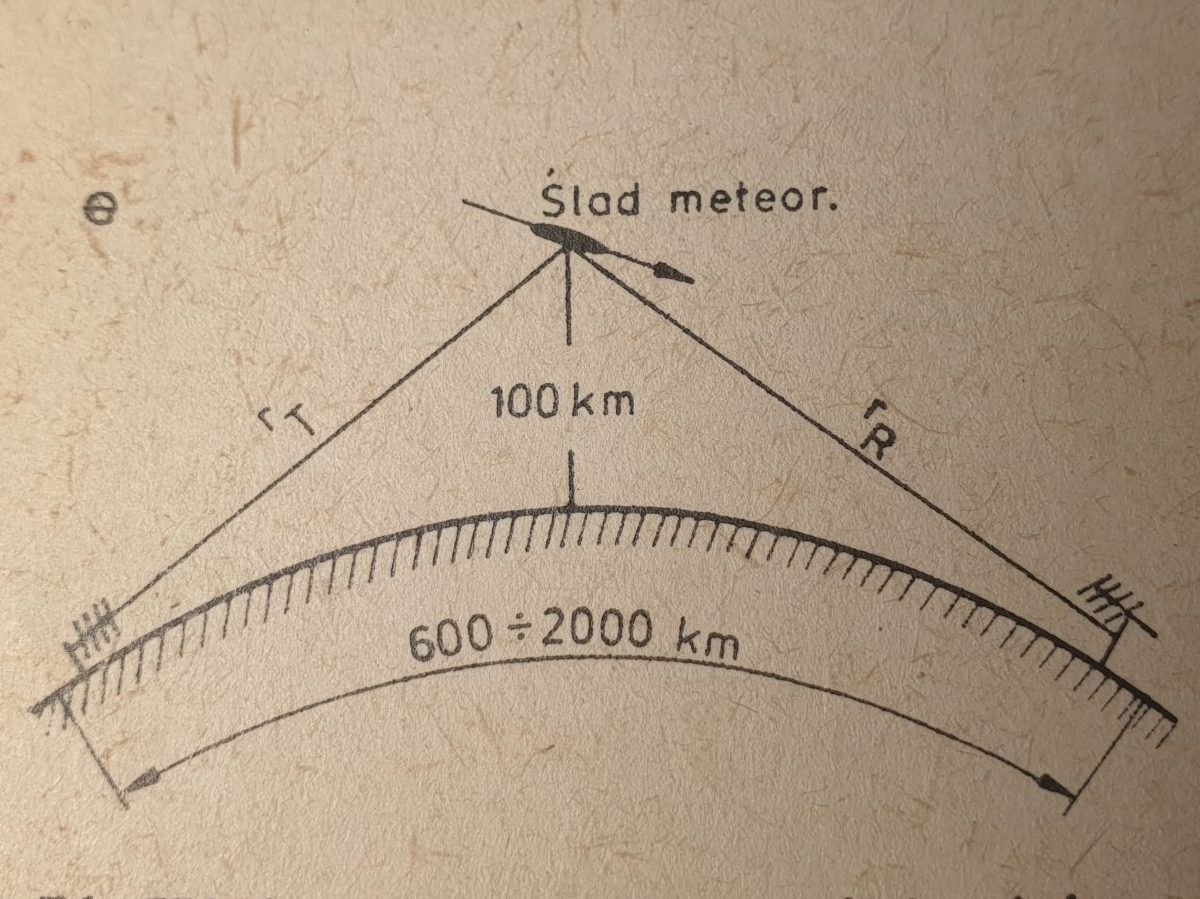
A meteor can leave an ionised trail that scatters a distant radio signal toward the receiver. Forward-scatter geometry is selective: only part of a shower can produce a useful reflection for a given transmitter and receiver arrangement.
FALSE POSITIVES AND AMBIGUITY
Signals that can mimic or contaminate a meteor echo
Aircraft
Moving aircraft can reflect VHF signals and create sloped, drifting or long-duration traces.
Satellites and space objects
Spacecraft, debris and re-entry events can reflect the monitored signal. GRAVES is itself a space-surveillance radar.
Propagation changes
Tropospheric enhancement, sporadic-E and other ionospheric conditions can raise or reshape signals that are normally weak.
Other transmitters
Co-channel or nearby transmitters, harmonics and transmitter changes can enter the observed passband.
Local interference
Electrical equipment, switching supplies and nearby RF sources can create short pulses or structured traces.
Receiver and software artefacts
Overload, buffer discontinuities, gain changes and DSP transients can be recorded as events even when no external reflection occurred.
RADIANTS
How the shower maps should be read
A radiant is the apparent direction from which meteors in a shower arrive. The daily maps show where active visual-shower radiants sit among the stars and when each radiant rises, culminates and sets as seen from SO8OO. They deliberately show astronomical sky context, not the GRAVES radio path.
A record made while the Perseids are active is not automatically a Perseid. Calendar overlap, radiant altitude and expected activity can support a hypothesis only after the echo morphology and the forward-scatter geometry are considered. A single receiver normally cannot derive an individual meteor trajectory or shower membership.
CORROBORATION
What increases confidence
- Time-frequency morphology consistent with an underdense or overdense meteor trail rather than a slowly moving reflector.
- Agreement between duration, Doppler evolution and the expected observing geometry.
- A simultaneous optical all-sky detection with a compatible UTC timestamp and direction.
- Independent reception by another station, ideally with enough geometry for a multi-station solution.
- Stable receiver settings, known uptime and review of local interference around the event.
Very strong, unusually long or repeated signals deserve more scrutiny, not an automatic "large meteor" label.
COUNTS AND CALIBRATION
Radio counts are not visual ZHR
ZHR is a visual reference rate under idealised conditions with the radiant overhead. Archive counts depend on transmitter and receiver geometry, frequency, antenna pattern, detection threshold, local noise, downtime and radiant position. They are useful for comparing this installation with itself when its configuration is stable, but they are not directly interchangeable with visual ZHR or another station's raw count.
Displayed dB-above-floor values describe signal contrast in this receiving pipeline; they are not an absolute calibrated meteor flux. UTC and time-synchronisation information should be retained whenever records are used for correlation.
PRIMARY REFERENCES